
Book a meeting

Data lake and warehousing

How to Streamline Operations by Fixing Fragmented Data

Having data spread across multiple systems in healthcare leads to slow decisions and increased compliance risk. Without a centralised view it is nearly impossible to manage data efficiently or maintain regulatory standards.

Patient recordsBillingOperationalPart of it, in three placesOne record, complete
The short answer

We specialise in consolidating fragmented data into a centralised platform. With real-time reporting and a unified structure, data stays consistent, accessible and compliant with healthcare regulation.

The problem, and the way out of it

Fragmented data across multiple systems.

The problem

Disparate sources and compliance risk

When data is scattered across departments and systems it becomes difficult to pull together an accurate, comprehensive view. That slows decision-making and raises compliance issues, which puts the organisation at risk.
The solution

A centralised data management platform

We specialise in consolidating fragmented data into a centralised platform. With real-time reporting and a unified structure, data stays consistent, accessible and compliant with healthcare regulation.

How we can help

What we would actually do.

Three things, and the first one usually pays for the rest.

123
Data consolidation across systemsBringing together data from all your disparate systems — patient records, billing, operational — into one platform.
Real-time reportingData updated in real time, so reports are generated quickly and accurately rather than assembled.
Compliance managementMaking sure the data structure meets the necessary healthcare regulation, which reduces the risk of non-compliance penalties.

Immediate benefits

What changes straight away.

Improved decision-making

A complete, real-time view of operations makes decisions faster and better informed.

Reduced compliance risk

Data that complies with industry regulation reduces the risk of audits and penalties.

Consistency and accessibility

A centralised system means data is consistent and reachable, which breaks down the departmental silos.

The original

This page, as the one-pager it came from.

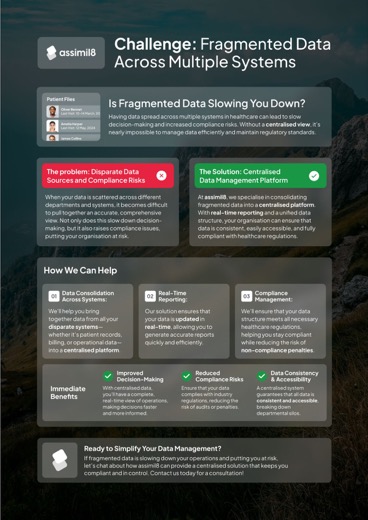
Everything above is on this sheet. It’s a nicely made thing and some people would rather forward a PDF than a link, so it’s here too - no form, nothing gated.

The How to Streamline Operations by Fixing Fragmented Data one-pager

Where this goes next

Data engineering

This question sits inside a bigger piece of work. If it’s the one bothering you, that page is where the detail is.

Before you book

The questions this raises.

Is fragmented data slowing you down?

Having data spread across multiple systems in healthcare leads to slow decisions and increased compliance risk. Without a centralised view it is nearly impossible to manage data efficiently or maintain regulatory standards.

What causes it?

When data is scattered across departments and systems it becomes difficult to pull together an accurate, comprehensive view. That slows decision-making and raises compliance issues, which puts the organisation at risk.

What does assimil8 do about it?

We specialise in consolidating fragmented data into a centralised platform. With real-time reporting and a unified structure, data stays consistent, accessible and compliant with healthcare regulation.

What changes first?

A complete, real-time view of operations makes decisions faster and better informed.

Do I have to fill in a form to read this?

No. The whole one-pager is on this page, and the original PDF is there to download without giving us anything.

If this is your problem

Tell us how it works at the moment.

If fragmented data is slowing your operations and putting you at risk, a centralised approach is usually the thing that fixes both at once.

Send it over

Where shall we send it?

Name, email and a number, and it’s with you in a minute.